CosmosObservatory
Explore
Solar System
Live
Learn
Tools
About
Cosmos Observatory
ToolsAbout
Cosmos Observatory

Explore the universe through NASA data, real-time ISS tracking, Mars rover imagery, asteroid monitoring, and comprehensive space encyclopedia. Your gateway to the cosmos.

Explore

  • APOD
  • Mars Rovers
  • Earth Imagery
  • NASA Gallery
  • ISS Tracker

Data

  • Asteroids
  • Solar System
  • Exoplanets
  • Space Weather
  • Launches

Tools

  • Glossary
  • News
  • Calculators

Legal

  • About
  • Privacy Policy
  • Terms of Use
  • Space Tools
  • Contact

Stay updated with the cosmos

Get weekly digests of APOD highlights, upcoming launches, and space events.

© 2026 Cosmos Observatory. All rights reserved. Built with for space enthusiasts.

This website is not affiliated with, maintained, authorized, endorsed by, or in any way officially connected with NASA or any of its subsidiaries or affiliates. All NASA imagery is in the public domain unless otherwise noted. Data sourced from NASA Open APIs, Launch Library 2, and other open data services.

  1. Home
  2. APOD
  3. April 4, 2014
APOD

Along the Western Veil

April 4, 2014
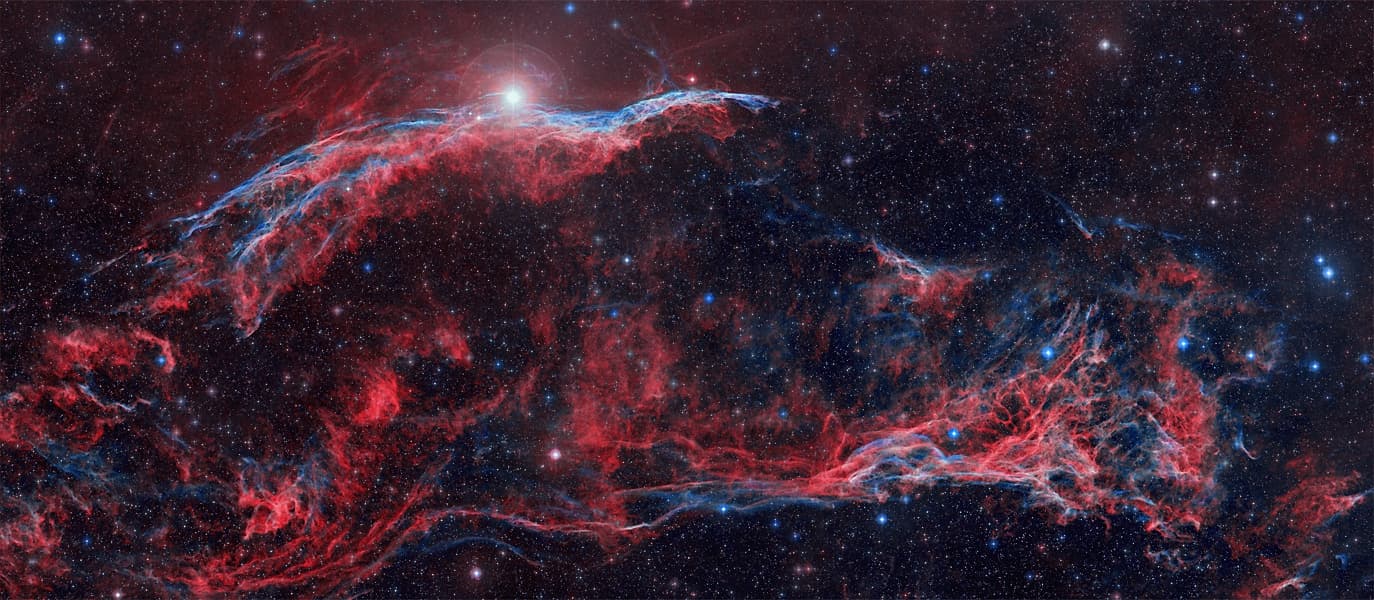
NASA APOD April 4, 2014: Along the Western VeilFull Resolution
PreviousApril 3, 2014
Today
NextApril 5, 2014

About This Image

Delicate in appearance, these filaments of shocked, glowing gas, draped in planet Earth's sky toward the constellation of Cygnus, make up the western part of the Veil Nebula. The Veil Nebula itself is a large supernova remnant, an expanding cloud born of the death explosion of a massive star. Light from the original supernova explosion likely reached Earth over 5,000 years ago. Blasted out in the cataclysmic event, the interstellar shock wave plows through space sweeping up and exciting interstellar material. The glowing filaments are really more like long ripples in a sheet seen almost edge on, remarkably well separated into atomic hydrogen (red) and oxygen (blue-green) gas. Also known as the Cygnus Loop, the Veil Nebula now spans nearly 3 degrees or about 6 times the diameter of the full Moon. While that translates to over 70 light-years at its estimated distance of 1,500 light-years, this wide image of the western portion spans about half that distance. Brighter parts of the western Veil are recognized as separate nebulae, including The Witch's Broom (NGC 6960) along the top of this view and Pickering's Triangle (NGC 6979) below and right of center.

Share

Full Archive

Browse by month since 1995

Mars Rover Photos

Curiosity & Perseverance

NASA Gallery

140,000+ space images

More From the Archive

APOD: An Iridescent Cloud Over Colorado - November 25, 2007

November 25, 2007

An Iridescent Cloud Over Colorado

APOD: HETE-2 Rides Pegasus - October 12, 2000

October 12, 2000

HETE-2 Rides Pegasus

APOD: Comet Hale-Bopp Over Val Parola Pass - August 8, 1999

August 8, 1999

Comet Hale-Bopp Over Val Parola Pass

APOD: Balloon TIGER - February 1, 2002

February 1, 2002

Balloon TIGER

APOD: Abell 3827: Cannibal Cluster Gravitational Lens - August 23, 2021

August 23, 2021

Abell 3827: Cannibal Cluster Gravitational Lens

Today's APOD

View the latest picture

Full Archive

Since June 16, 1995

Exoplanet Explorer

5,700+ confirmed worlds