CosmosObservatory
Explore
Solar System
Live
Learn
Tools
About
Cosmos Observatory
ToolsAbout
Cosmos Observatory

Explore the universe through NASA data, real-time ISS tracking, Mars rover imagery, asteroid monitoring, and comprehensive space encyclopedia. Your gateway to the cosmos.

Explore

  • APOD
  • Mars Rovers
  • Earth Imagery
  • NASA Gallery
  • ISS Tracker

Data

  • Asteroids
  • Solar System
  • Exoplanets
  • Space Weather
  • Launches

Tools

  • Glossary
  • News
  • Calculators

Legal

  • About
  • Privacy Policy
  • Terms of Use
  • Space Tools
  • Contact

Stay updated with the cosmos

Get weekly digests of APOD highlights, upcoming launches, and space events.

© 2026 Cosmos Observatory. All rights reserved. Built with for space enthusiasts.

This website is not affiliated with, maintained, authorized, endorsed by, or in any way officially connected with NASA or any of its subsidiaries or affiliates. All NASA imagery is in the public domain unless otherwise noted. Data sourced from NASA Open APIs, Launch Library 2, and other open data services.

  1. Home
  2. APOD
  3. October 4, 2012
APOD

NGC 7293: The Helix Nebula

October 4, 2012Martin Pugh
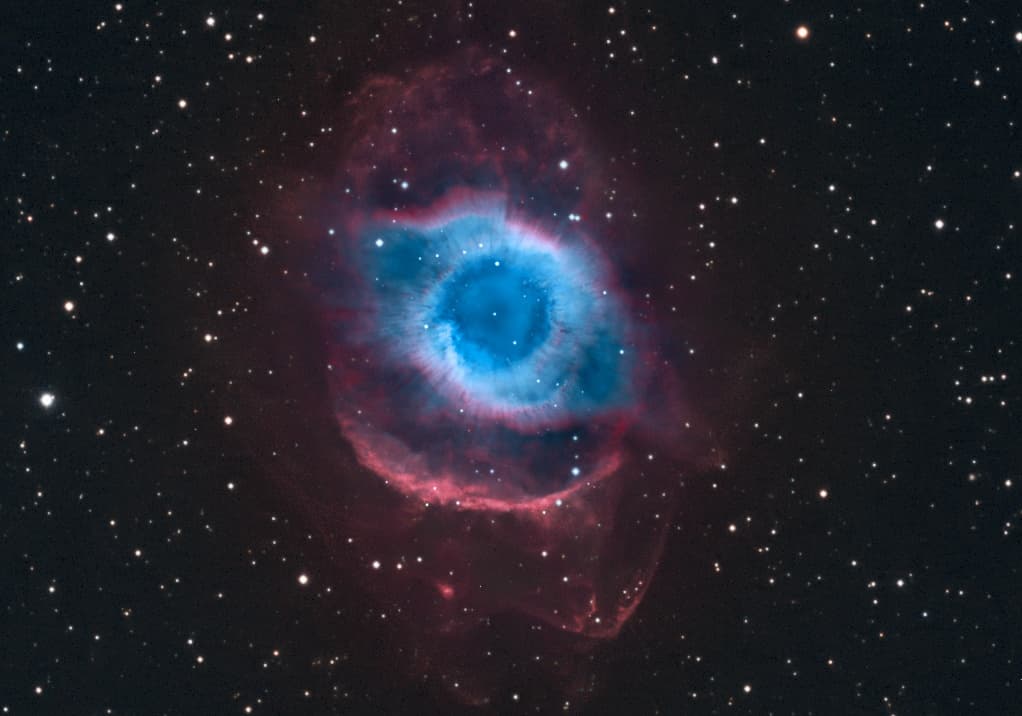
NASA APOD October 4, 2012: NGC 7293: The Helix NebulaFull Resolution
PreviousOctober 3, 2012
Today
NextOctober 5, 2012

About This Image

A mere seven hundred light years from Earth, in the constellation Aquarius, a sun-like star is dying. Its last few thousand years have produced the Helix Nebula (NGC 7293), a well studied and nearby example of a Planetary Nebula, typical of this final phase of stellar evolution. A total of 58 hours of exposure time have gone in to creating this deep view of the nebula. Accumulating narrow band data from emission lines of hydrogen atoms in red and oxygen atoms in blue-green hues, it shows remarkable details of the Helix's brighter inner region, about 3 light-years across, but also follows fainter outer halo features that give the nebula a span of well over six light-years. The white dot at the Helix's center is this Planetary Nebula's hot, central star. A simple looking nebula at first glance, the Helix is now understood to have a surprisingly complex geometry.

On This Day in Space History

On October 4, 1957, the Soviet Union launched Sputnik 1, the first artificial satellite, beginning the Space Age.

Share

Full Archive

Browse by month since 1995

Mars Rover Photos

Curiosity & Perseverance

NASA Gallery

140,000+ space images

More From the Archive

APOD: Oceans Under Jupiter's Moon Ganymede? - December 18, 2000

December 18, 2000

Oceans Under Jupiter's Moon Ganymede?

APOD: The Tarantula Nebula - February 26, 2016

February 26, 2016

The Tarantula Nebula

APOD: NASA's Latest Rockets: X-33 - July 2, 1996

July 2, 1996

NASA's Latest Rockets: X-33

APOD: A Cerro Tololo Sky - August 6, 2006

August 6, 2006

A Cerro Tololo Sky

APOD: Comet Tempel 1 from Stardust-NeXT Spacecraft - February 16, 2011

February 16, 2011

Comet Tempel 1 from Stardust-NeXT Spacecraft

Today's APOD

View the latest picture

Full Archive

Since June 16, 1995

Exoplanet Explorer

5,700+ confirmed worlds