CosmosObservatory
Explore
Solar System
Live
Learn
Tools
About
Cosmos Observatory
ToolsAbout
Cosmos Observatory

Explore the universe through NASA data, real-time ISS tracking, Mars rover imagery, asteroid monitoring, and comprehensive space encyclopedia. Your gateway to the cosmos.

Explore

  • APOD
  • Mars Rovers
  • Earth Imagery
  • NASA Gallery
  • ISS Tracker

Data

  • Asteroids
  • Solar System
  • Exoplanets
  • Space Weather
  • Launches

Tools

  • Glossary
  • News
  • Calculators

Legal

  • About
  • Privacy Policy
  • Terms of Use
  • Space Tools
  • Contact

Stay updated with the cosmos

Get weekly digests of APOD highlights, upcoming launches, and space events.

© 2026 Cosmos Observatory. All rights reserved. Built with for space enthusiasts.

This website is not affiliated with, maintained, authorized, endorsed by, or in any way officially connected with NASA or any of its subsidiaries or affiliates. All NASA imagery is in the public domain unless otherwise noted. Data sourced from NASA Open APIs, Launch Library 2, and other open data services.

  1. Home
  2. APOD
  3. September 4, 2010
APOD

Young Suns of NGC 7129

September 4, 2010Ken Crawford
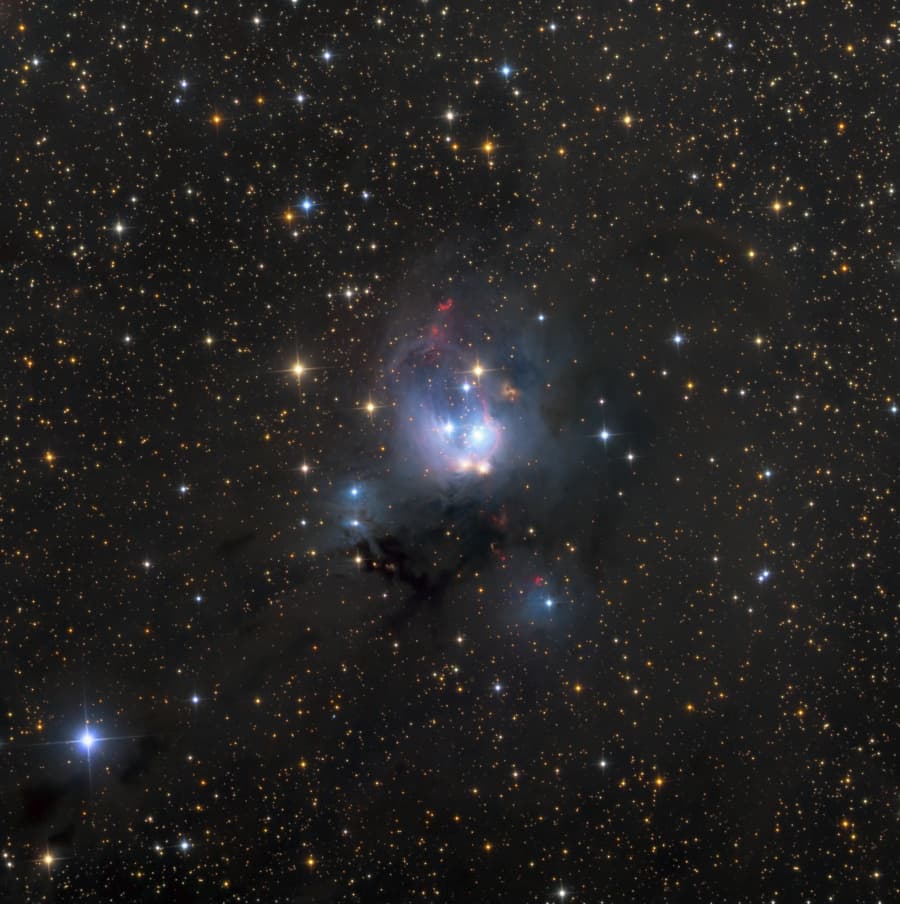
NASA APOD September 4, 2010: Young Suns of NGC 7129Full Resolution
PreviousSeptember 3, 2010
Today
NextSeptember 5, 2010

About This Image

Young suns still lie within dusty NGC 7129, some 3,000 light-years away toward the royal constellation Cepheus. While these stars are at a relatively tender age, only a few million years old, it is likely that our own Sun formed in a similar stellar nursery some five billion years ago. Most noticeable in the sharp, (zoomable) image are the lovely bluish dust clouds that reflect the youthful starlight, but the smaller, deep red crescent shapes are also markers of energetic, young stellar objects. Known as Herbig-Haro objects, their shape and color is characteristic of glowing hydrogen gas shocked by jets streaming away from newborn stars. Ultimately the natal gas and dust in the region will be dispersed, the stars drifting apart as the loose cluster orbits the center of the Galaxy. At the estimated distance of NGC 7129, this telescopic view spans about 40 light-years. Take a short survey about viewing astronomy images on mobile devices.

Share

Full Archive

Browse by month since 1995

Mars Rover Photos

Curiosity & Perseverance

NASA Gallery

140,000+ space images

More From the Archive

APOD: Nearby Dwarf Galaxy Leo I - May 19, 1996

May 19, 1996

Nearby Dwarf Galaxy Leo I

APOD: Aurora and Milky Way in a Little Sky - October 3, 2014

October 3, 2014

Aurora and Milky Way in a Little Sky

APOD: M2-9: Wings of a Butterfly Nebula - December 27, 1998

December 27, 1998

M2-9: Wings of a Butterfly Nebula

APOD: Orion's Horsehead Nebula - October 25, 1997

October 25, 1997

Orion's Horsehead Nebula

APOD: IFN and the NGC 7771 Group - August 31, 2024

August 31, 2024

IFN and the NGC 7771 Group

Today's APOD

View the latest picture

Full Archive

Since June 16, 1995

Exoplanet Explorer

5,700+ confirmed worlds