CosmosObservatory
Explore
Solar System
Live
Learn
Tools
About
Cosmos Observatory
ToolsAbout
Cosmos Observatory

Explore the universe through NASA data, real-time ISS tracking, Mars rover imagery, asteroid monitoring, and comprehensive space encyclopedia. Your gateway to the cosmos.

Explore

  • APOD
  • Mars Rovers
  • Earth Imagery
  • NASA Gallery
  • ISS Tracker

Data

  • Asteroids
  • Solar System
  • Exoplanets
  • Space Weather
  • Launches

Tools

  • Glossary
  • News
  • Calculators

Legal

  • About
  • Privacy Policy
  • Terms of Use
  • Space Tools
  • Contact

Stay updated with the cosmos

Get weekly digests of APOD highlights, upcoming launches, and space events.

© 2026 Cosmos Observatory. All rights reserved. Built with for space enthusiasts.

This website is not affiliated with, maintained, authorized, endorsed by, or in any way officially connected with NASA or any of its subsidiaries or affiliates. All NASA imagery is in the public domain unless otherwise noted. Data sourced from NASA Open APIs, Launch Library 2, and other open data services.

  1. Home
  2. APOD
  3. September 1, 2003
APOD

A Beautiful Trifid

September 1, 2003Jim and Janet Castano, Adam Block, NOAO, AURA, NSF
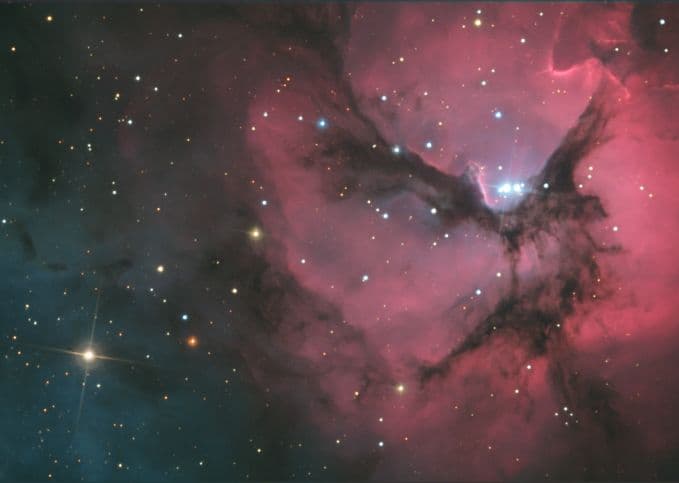
NASA APOD September 1, 2003: A Beautiful TrifidFull Resolution
PreviousAugust 31, 2003
Today
NextSeptember 2, 2003

About This Image

The beautiful Trifid Nebula (aka M20), a photogenic study in cosmic contrasts, lies about 5,000 light-years away toward the nebula rich constellation Sagittarius. A star forming region in the plane of our galaxy, the Trifid alone illustrates three basic types of astronomical nebulae; red emission nebulae dominated by light from hydrogen atoms, blue reflection nebulae produced by dust reflecting starlight, and dark absorption nebulae where dense dust clouds appear in silhouette. The bright emission nebula on the right, separated into three parts by obscuring dust lanes, lends the nebula its popular name. Many details are apparent in this gorgeous high-resolution image of the Trifid. For example, light-year long pillars and jets sculpted by newborn stars - visible here in the upper right-hand corner of the emission nebula - appear in Hubble Space Telescope close-up images of the region.

Share

Full Archive

Browse by month since 1995

Mars Rover Photos

Curiosity & Perseverance

NASA Gallery

140,000+ space images

More From the Archive

Today's APOD

View the latest picture

Full Archive

Since June 16, 1995

Exoplanet Explorer

5,700+ confirmed worlds