CosmosObservatory
Explore
Solar System
Live
Learn
Tools
About
Cosmos Observatory
ToolsAbout
Cosmos Observatory

Explore the universe through NASA data, real-time ISS tracking, Mars rover imagery, asteroid monitoring, and comprehensive space encyclopedia. Your gateway to the cosmos.

Explore

  • APOD
  • Mars Rovers
  • Earth Imagery
  • NASA Gallery
  • ISS Tracker

Data

  • Asteroids
  • Solar System
  • Exoplanets
  • Space Weather
  • Launches

Tools

  • Glossary
  • News
  • Calculators

Legal

  • About
  • Privacy Policy
  • Terms of Use
  • Space Tools
  • Contact

Stay updated with the cosmos

Get weekly digests of APOD highlights, upcoming launches, and space events.

© 2026 Cosmos Observatory. All rights reserved. Built with for space enthusiasts.

This website is not affiliated with, maintained, authorized, endorsed by, or in any way officially connected with NASA or any of its subsidiaries or affiliates. All NASA imagery is in the public domain unless otherwise noted. Data sourced from NASA Open APIs, Launch Library 2, and other open data services.

  1. Home
  2. APOD
  3. May 14, 2002
APOD

N44C: A Nebular Mystery

May 14, 2002
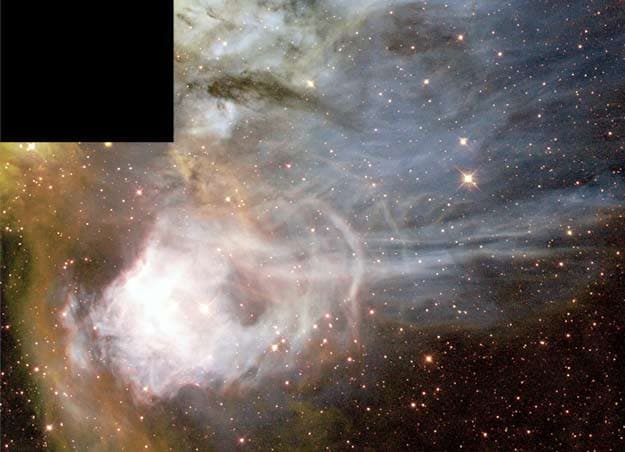
NASA APOD May 14, 2002: N44C: A Nebular MysteryFull Resolution
PreviousMay 13, 2002
Today
NextMay 15, 2002

About This Image

Why is N44C glowing so strangely? The star that appears to power the nebula, although young and bright, does not seem hot enough to create some of the colors observed. A search for a hidden hotter star in X-rays has come up empty. One hypothesis is that the known central star has a neutron star companion in a very wide orbit. Hot X-rays might only then be emitted during brief periods when the neutron star nears the known star and crashes through a disk of surrounding gas. Future observations might tell. N44C, pictured in the above Hubble Space Telescope image, is an emission nebula in the Large Magellanic Cloud, a neighboring galaxy to our Milky Way Galaxy. Flowing filaments of colorful gas and dark dust far from the brightest region are likely part of the greater N44 complex. It would take light about 125 years to cross N44C.

Share

Full Archive

Browse by month since 1995

Mars Rover Photos

Curiosity & Perseverance

NASA Gallery

140,000+ space images

More From the Archive

APOD: SuitSat-1: A Spacesuit Floats Free - April 27, 2014

April 27, 2014

SuitSat-1: A Spacesuit Floats Free

APOD: Partial Solar Eclipse over Argentina - May 2, 2022

May 2, 2022

Partial Solar Eclipse over Argentina

APOD: M1: The Crab Nebula from Hubble - September 9, 2018

September 9, 2018

M1: The Crab Nebula from Hubble

APOD: Lulin and Saturn near Opposition - February 27, 2009

February 27, 2009

Lulin and Saturn near Opposition

APOD: Suiting Up for the Moon - April 1, 2015

April 1, 2015

Suiting Up for the Moon

Today's APOD

View the latest picture

Full Archive

Since June 16, 1995

Exoplanet Explorer

5,700+ confirmed worlds