CosmosObservatory
Explore
Solar System
Live
Learn
Tools
About
Cosmos Observatory
ToolsAbout
Cosmos Observatory

Explore the universe through NASA data, real-time ISS tracking, Mars rover imagery, asteroid monitoring, and comprehensive space encyclopedia. Your gateway to the cosmos.

Explore

  • APOD
  • Mars Rovers
  • Earth Imagery
  • NASA Gallery
  • ISS Tracker

Data

  • Asteroids
  • Solar System
  • Exoplanets
  • Space Weather
  • Launches

Tools

  • Glossary
  • News
  • Calculators

Legal

  • About
  • Privacy Policy
  • Terms of Use
  • Space Tools
  • Contact

Stay updated with the cosmos

Get weekly digests of APOD highlights, upcoming launches, and space events.

© 2026 Cosmos Observatory. All rights reserved. Built with for space enthusiasts.

This website is not affiliated with, maintained, authorized, endorsed by, or in any way officially connected with NASA or any of its subsidiaries or affiliates. All NASA imagery is in the public domain unless otherwise noted. Data sourced from NASA Open APIs, Launch Library 2, and other open data services.

  1. Home
  2. APOD
  3. October 4, 1997
APOD

In the Center of 30 Doradus

October 4, 1997
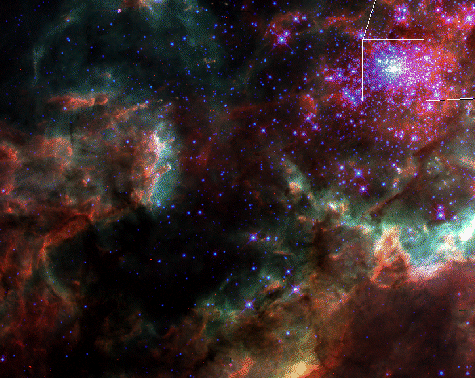
NASA APOD October 4, 1997: In the Center of 30 DoradusFull Resolution
PreviousOctober 3, 1997
Today
NextOctober 5, 1997

About This Image

In the center of 30 Doradus lies a huge cluster of the largest, hottest, most massive stars known. The center of this cluster, known as R136, is boxed in the upper right portion of the above picture. The gas and dust filling the rest of the picture is predominantly ionized hydrogen from the emission nebula 30 Doradus. R136 is composed of thousands of hot blue stars, some about 50 times more massive than our Sun. 30 Doradus and R136 lie in the LMC - a satellite galaxy to our own Milky Way Galaxy. Although the ages of stars in R136 cause it to be best described as an open cluster, R136's density will likely make it a low mass globular cluster in a few billion years.

On This Day in Space History

On October 4, 1957, the Soviet Union launched Sputnik 1, the first artificial satellite, beginning the Space Age.

Share

Full Archive

Browse by month since 1995

Mars Rover Photos

Curiosity & Perseverance

NASA Gallery

140,000+ space images

More From the Archive

Today's APOD

View the latest picture

Full Archive

Since June 16, 1995

Exoplanet Explorer

5,700+ confirmed worlds