APOD
ASCA X-Ray Observatory
February 20, 1996
About This Image
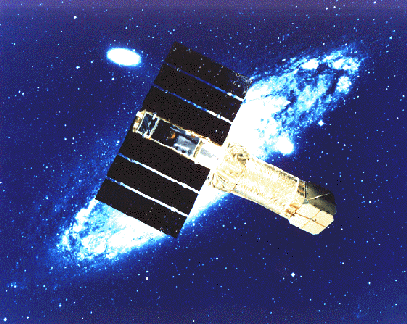
Today marks the third anniversary of the launch of the Advanced Satellite for Cosmology and Astrophysics (ASCA; renamed from Astro D when launched). ASCA, seen here superposed on galaxy M31, is a Japanese satellite for which NASA has provided some scientific equipment. ASCA carries four large-area X-ray telescopes. At the focus of two of the telescopes is a Gas Imaging Spectrometer (GIS), while a Solid-state Imaging Spectrometer (SIS) is at the focus of the other two. ASCA has provided recent evidence that high energy cosmic rays are formed in the expanding gas from a supernova. During ASCA's three years of operation, it has also yielded valuable data on quasars, supernova remnants, dwarf novae, pulsars, clusters of galaxies, and the mysterious X-ray background radiation that appears to come from all directions.
On This Day in Space History
On February 20, 1962, John Glenn became the first American to orbit Earth aboard Friendship 7.
Share