Live Space Data
Explore the Cosmos
Through NASA Data
Real-time ISS tracking, Mars rover imagery, asteroid monitoring, and the universe's most stunning photographs -- all powered by NASA open data APIs.
Asteroids Today
5
ISS Location
-40.8°, 145.2°
Mars Sol (Curiosity)
4400+
Live
ISS Position: -40.77, 145.22 | Altitude: ~408 kmLiveClosest asteroid today: 2014 KG39 at 13,311,906 km5 near-Earth asteroids tracked today23 solar flares detected in the past 30 daysToday's APOD: "The Hydra Cluster of Galaxies"2 Mars rovers actively exploring the Red PlanetISS Position: -40.77, 145.22 | Altitude: ~408 kmLiveClosest asteroid today: 2014 KG39 at 13,311,906 km5 near-Earth asteroids tracked today23 solar flares detected in the past 30 daysToday's APOD: "The Hydra Cluster of Galaxies"2 Mars rovers actively exploring the Red Planet
Your Free Online Space Observatory
Cosmos Observatory is a comprehensive, free platform for exploring the universe using real NASA data and open-source space APIs. Whether you are a seasoned astronomer, a student learning about the cosmos, or simply someone who gazes at the night sky in wonder, our tools bring the latest discoveries from space agencies directly to your screen. From the breathtaking daily photographs featured in NASA's Astronomy Picture of the Day (APOD) to live telemetry from the International Space Station orbiting 408 kilometers above Earth, every piece of data here is sourced from official scientific instruments and missions.
Our platform aggregates data from multiple NASA APIs including the Near Earth Object Web Service for asteroid tracking, the Mars Rover Photos API for images captured on the Martian surface by Curiosity and Perseverance, the DONKI API for solar weather monitoring, and the NASA Image and Video Library for searching over 140,000 publicly available space images in our gallery. We also feature an interactive solar system explorer, a comprehensive exoplanet database with over 5,700 confirmed worlds, rocket launch schedules, Earth observation imagery from the EPIC camera aboard the DSCOVR satellite, and an educational glossary of astronomy terms. All data refreshes automatically so you always have access to the most current information available.
Explore
Your Gateway to Space
Dive into live data from NASA missions, track near-Earth objects, and explore the wonders of our universe.
Active
Mars Rovers
Browse thousands of photos from Curiosity and Perseverance on the Martian surface. Explore the Red Planet through NASA rover cameras.
Explore
Near-Earth Asteroids
5
Closest: 2014 KG39
View details
Live
ISS Tracker
Currently at -40.8, 145.2 traveling at ~27,600 km/h. Track the station live on our interactive map.
Explore
Solar Flares (30d)
23
Detected solar events
View details
Astronomy Picture of the Day
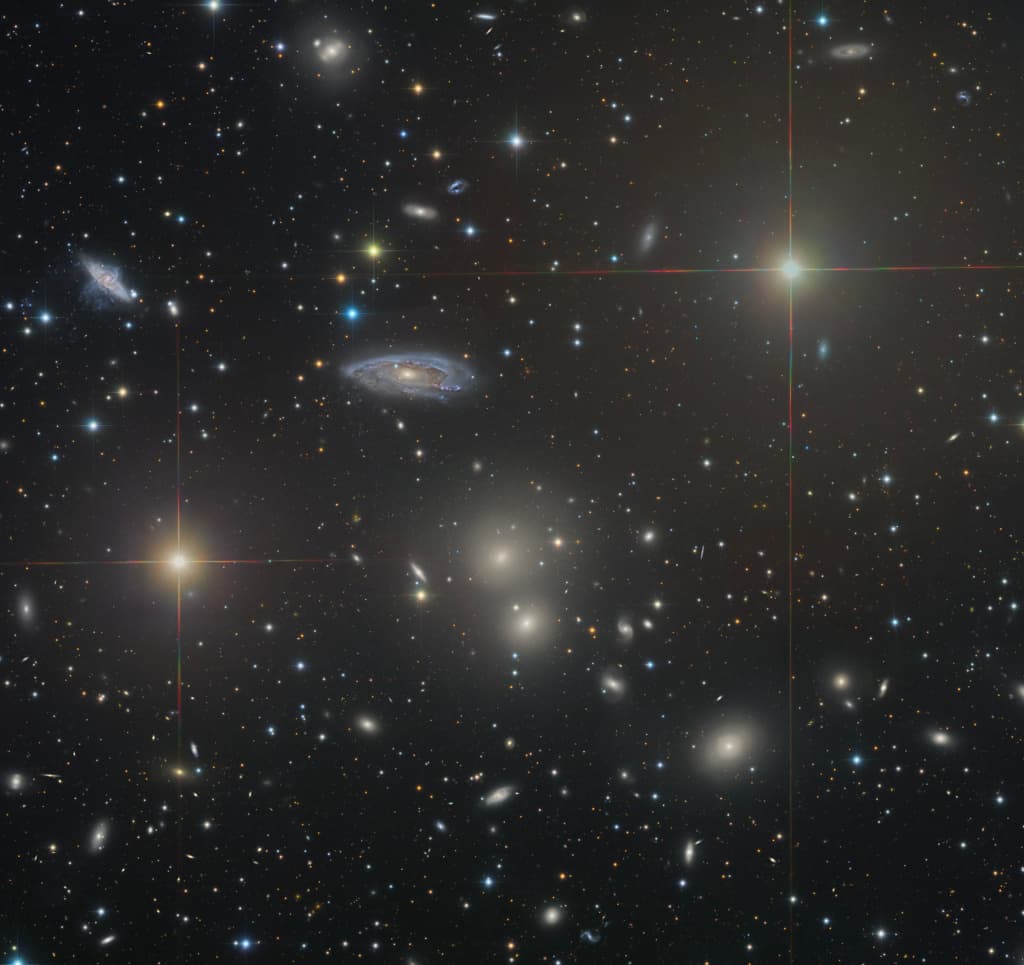
The Hydra Cluster of Galaxies
June 5, 2026 | © Rafael Sampaio
Within our own Milky Way galaxy, two bright, spiky stars stand like sentinels in the foreground of this cosmic snapshot. Far beyond them are the galaxies of the Hydra Cluster. In fact, while the spiky foreground stars are hundreds of light-years distant, the Hydra Cluster galaxies are well over 100 million light-years away. Three large galaxies near the cluster center, two yellow ellipticals (NGC 3311, NGC 3309) and one prominent blue spiral (NGC 3312), are the dominant galaxies, each about 150,000 light-years in diameter. An intriguing overlapping galaxy pair cataloged as NGC 3314 lies above and left of NGC 3312. Also known as Abell 1060, the Hydra galaxy cluster is one of three large galaxy clusters within 200 million light-years of the Milky Way. In the nearby universe, galaxies are gravitationally bound into clusters which themselves are loosely bound into superclusters. Superclusters in turn are seen to align over even larger scales.
View Full APODResources
Space Knowledge Hub
Deepen your understanding of the cosmos with our curated educational resources, interactive astronomy tools, and comprehensive space encyclopedias.
Space & Astronomy Glossary
From accretion disks to zenith, explore hundreds of space science terms explained in plain language. Perfect for students, educators, and curious minds navigating the language of the cosmos.
Browse termsInteractive Space Tools
Calculate interplanetary distances, convert astronomical units, and discover what's visible in the night sky tonight. Free tools built for amateur astronomers and space enthusiasts.
Explore toolsAbout Cosmos Observatory
Learn how we bring real-time NASA data to your screen. Discover our mission to make space exploration accessible through open data, interactive visualizations, and community-driven science education.
Our missionBy the Numbers
The Scale of Discovery
Humanity's ever-growing catalogue of cosmic observations, from our neighboring asteroids to distant exoplanets.
0+APOD Images Published
0+Known Near-Earth Asteroids
0+Confirmed Exoplanets
0+Mars Sols Explored
Common Questions
Frequently Asked Questions
Learn more about Cosmos Observatory, our data sources, and how to explore the universe.
What is APOD (Astronomy Picture of the Day)?
APOD stands for Astronomy Picture of the Day, a NASA program that has published one unique astronomy image or photograph every day since June 16, 1995. Each image is accompanied by a brief explanation written by a professional astronomer. APOD has become one of the most popular science websites, with millions of monthly visitors exploring galaxies, nebulae, planets, and other cosmic phenomena.
How can I track near-Earth asteroids in real time?
Cosmos Observatory provides a live asteroid tracker powered by NASA's NeoWs (Near Earth Object Web Service) API. You can monitor asteroids making close approaches to Earth, view their estimated diameters, velocities, miss distances, and whether they are classified as potentially hazardous. Our tracker updates every 15 minutes with the latest data from NASA's Center for Near Earth Object Studies (CNEOS).
What is the International Space Station (ISS) and how do I track it?
The International Space Station is a modular space station in low Earth orbit, orbiting at approximately 408 km altitude and traveling at roughly 27,600 km/h. It completes one orbit every 90 minutes. Our ISS Tracker page shows the station's real-time position on an interactive map, displays current crew members, and provides orbital data including latitude, longitude, and altitude updated every few seconds.
How many exoplanets have been discovered so far?
As of 2025, NASA has confirmed over 5,700 exoplanets -- planets orbiting stars outside our solar system. These discoveries come from missions like Kepler, TESS, and ground-based observatories using techniques such as the transit method and radial velocity. Our Exoplanet Explorer lets you filter and explore these worlds by discovery method, size, temperature, orbital period, and habitable zone status.
Stay Connected to the Cosmos
Get weekly highlights: the best APOD picks, asteroid close approaches, mission updates, and space weather alerts delivered to your inbox.
No spam. Unsubscribe at any time. We respect your privacy.